
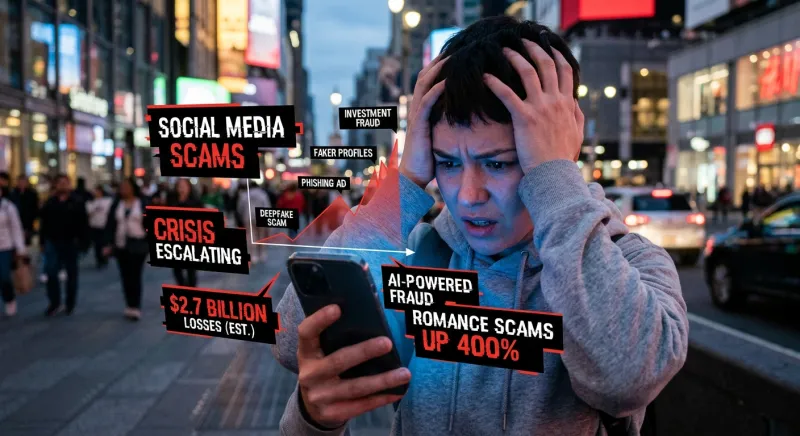
In the early 2000s, social media was heralded as the great equalizer—a digital town square where humanity could convene, share, and connect across oceans. Two decades later, that open square has become a dimly lit alleyway where the pickpockets are no longer human, but sophisticated, AI-driven algorithms and syndicates operating from the shadows of global anonymity. Today, social media scams are not merely a nuisance; they are a systemic crisis, rising at an alarming rate that threatens the very foundation of digital trust.
The Evolution of Deception
The anatomy of the modern social media scam has transitioned from the clumsy, grammatically fractured "Nigerian Prince" emails of the past into highly personalized, psychologically honed campaigns. Fraudsters have evolved from mass-emailing to precision-targeting. By leveraging the vast troves of personal data voluntarily uploaded to platforms like Instagram, LinkedIn, and Facebook, scammers can craft narratives that feel intimately authentic.
Whether it is a fake investment opportunity appearing in a LinkedIn message, a compromised friend’s account messaging you on Instagram to urgent request "help" with a payment, or the proliferation of "get-rich-quick" cryptocurrency schemes masquerading as legitimate financial advice, the landscape is treacherous. The sophistication lies in the methodology: these criminals are no longer just casting a wide net; they are spear-fishing.
The Psychology of the Click
Why are we falling for them? The rise in successful scams is not necessarily a reflection of dwindling public intelligence, but rather a mastery of behavioral economics by bad actors. Social media platforms are designed to manufacture dopamine loops—the constant need for validation, news, and connection. Scammers exploit this by creating a sense of "false urgency" or "curated familiarity."
When a scammer compromises a legitimate account, they gain the most valuable asset in the digital security playbook: social proof. If a message comes from a trusted peer, our skepticism drops. If an advertisement is perfectly targeted to our specific browsing history and interests, the cognitive dissonance required to question its validity is high. We are constantly conditioned to engage with content on social media, blurring the lines between authentic interaction and predatory manipulation.
The AI Revolution: A Double-Edged Sword
The most alarming development in this surge is the integration of Generative AI. Fraudsters are now using Large Language Models (LLMs) to write flawless, conversational, and highly persuasive phishing messages. Gone are the days of spotting a scam by looking for typos or broken syntax.
Even more concerning is the rise of "Deepfake" technology. Cybercriminals are now cloning the voices and faces of trusted figures, family members, or influencers to authorize fraudulent transactions or solicit personal information. As AI becomes more accessible and cost-effective, the barrier to entry for novice scammers has virtually vanished, allowing them to scale their operations with minimal effort. This democratization of cybercrime is a primary driver for the exponential rise in reported incidents globally.
The Economic Toll and the Erosion of Trust
The financial damage caused by social media scams is staggering. According to recent reports from the Federal Trade Commission (FTC), billions of dollars are lost annually to scams originating on social media platforms. Unlike traditional banking fraud, where there is often a recourse mechanism or a robust regulatory framework to recover funds, social media scams often involve irreversible cryptocurrency transfers or untraceable digital payment apps.
Yet, the economic toll is only one side of the coin. The more profound damage is the erosion of institutional and social trust. When an individual discovers they have been betrayed by someone they believed was a recruiter, a family member, or a legitimate business contact, their subsequent reliance on digital infrastructure is permanently altered. We are entering an era of "zero-trust" social interaction, where the baseline assumption for any digital communication is skepticism. This paradigm shift threatens the collaborative potential of the internet, potentially turning social media into a fragmented, high-friction environment.
The Responsibility Gap: Platforms vs. Users
The debate over who bears the responsibility for this crisis is heated. Social media platforms argue that they are providers of a service and not, in effect, the guardians of every interaction that occurs within their walls. They point to their investment in content moderation and AI-driven detection as evidence of their commitment.
However, critics argue that the business model of social media—which prioritizes high engagement via algorithms—is inherently susceptible to manipulation. By amplifying sensational content and allowing hyper-targeted advertising with minimal oversight, these platforms create the fertile soil in which scams thrive. As long as the metrics for success are based on hours spent on the platform, the incentive to block a convincing but fraudulent advertisement is weighed against the loss of advertising revenue.
There is an urgent need for a more proactive regulatory approach. Governments around the world are beginning to hold platforms accountable for the content they promote, but legislation is often sluggish, lagging behind the speed of technological innovation.
Protecting the Digital Citizen
In the absence of a "magic bullet" to eradicate these scams, the burden of protection currently falls on the individual. Developing a "digital immune system" is now a survival skill. This involves several critical habits:
- Verification of Identity: If someone reaches out via private message, even if they appear to be a friend, verify their identity through a secondary, out-of-band communication method—a phone call or a text message.
- Skepticism of Urgency: Any communication that demands immediate financial action or threatens a negative consequence if you don’t "act now" is a major red flag.
- Privacy Hygiene: Limit the amount of personal information that is publicly viewable. Scammers use your birthday, your job history, and your location to build the very profiles they use to trick you.
- Advanced Security Protocols: Enable Multi-Factor Authentication (MFA) everywhere. It is the single most effective barrier against account takeover.
- Digital Literacy: We must normalize the conversation around scams. By reporting incidents to platforms and sharing knowledge within our communities, we strip scammers of their best weapon: our silence.
The Road Ahead
The surge in social media scams is a symptom of a larger digital evolution. We have integrated these platforms into the infrastructure of our daily lives, our financial transactions, and our professional identities, yet we have failed to build the corresponding security architecture to safeguard those activities.
We are at a tipping point. Either we continue to treat these scams as individual misfortunes within an expansive, chaotic ecosystem, or we demand a systemic shift in how platforms are regulated and secured. The future of the digital world depends on our ability to distinguish truth from artifice. Until then, we must navigate the digital landscape with the vigilance of a traveler in a city of mirrors, where everything we see is designed to catch our eye, but not everything is what it seems.
Social media is a miracle of human connection, but currently, it is also a testament to human vulnerability. It is time for users, regulators, and tech giants to cease viewing these scams as an unfortunate byproduct and start treating them as an existential threat to the digital experience.

Jessica Gills is a freelance writer carving a niche for herself by empowering others through her words. With a focus on careers, self-development, and business, she helps readers navigate the complexities of the modern professional landscape.
Related Posts
The Alarming Rise of Online Scams: A Growing Concern
Online scams are on the rise, and it's essential to stay informed about the latest tactics and techn... Read More

Unwanted Scam Calls Are Out of Control, How to Stop Them
The modern smartphone, once a marvel of connectivity, has increasingly become a conduit for agitatio... Read More

The Silent Ring Deception: How Visa Transaction Voicemail Scams are Designed to Trick You
In today's world of sophisticated scams, even the absence of a ringing phone can be a warning sign. ... Read More
Top Posts

Why Email Marketing Is Shifting to Interactive, AI‑Powered Campaigns
Explore the latest email marketing trends—AI‑generated copy, interactive content, micro‑targeting, and real‑time testing—that turn inboxes into highâ€...Read More

Sipping the Future: Botanical Mocktails Redefine Social Drinking
Botanical mocktails are transforming social drinking, offering complex flavors, health benefits, and compelling stories. Discover the rise of herb‑infused sip...Read More

Balcony Micro‑Ecosystems: Crafting a Sensory Garden in Small Spaces
Turn your balcony into a living sanctuary. Learn modular tools, smart soil tricks, and sensory planting to create a thriving micro‑ecosystem that feeds both b...Read More

ChatGPT as Your Everyday Creative Partner
Explore how ChatGPT transforms daily work—from idea generation and code snippets to mindful planning—while staying ethical and privacy‑smart....Read More
0 Comments
Post Comment
You will need to Login or Register to comment on this post!